For years, businesses and bloggers relied heavily on Search Engine Optimization to attract traffic from search engines. The traditional strategy was straightforward: research keywords, optimize web pages, build backlinks, and try to rank higher on search engine results pages.
But the way people search for information is rapidly evolving.
Today, search engines and AI tools increasingly provide direct answers instead of just a list of links. Platforms such as Google Search, ChatGPT, and Perplexity AI are transforming the search experience by delivering instant explanations, AI summaries, and conversational responses.
Instead of forcing users to browse multiple websites, these systems aim to provide complete answers immediately.
This shift has introduced new concepts in the world of search optimization: Answer Engine Optimization (AEO) and Generative Engine Optimization (GEO).
While traditional SEO focuses on ranking web pages, AEO focuses on providing clear answers, and GEO focuses on ensuring your content is referenced by AI systems when they generate responses.
In this guide, you will learn:
- What SEO, AEO, and GEO actually mean
- How AI is reshaping the search landscape
- The key differences between these strategies
- Practical ways to optimize content for AI-driven search in 2026 and beyond
Understanding these changes is essential for bloggers, businesses, and marketers who want to stay visible in the rapidly evolving search ecosystem.
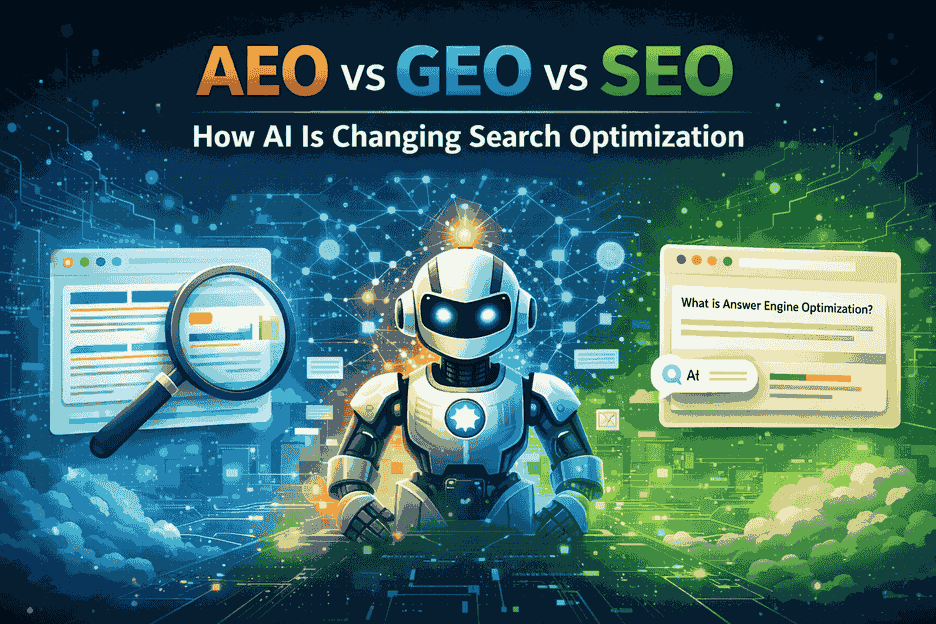
AEO vs GEO vs SEO Explained
AEO, GEO, and SEO are three different approaches to search optimization in the AI era.
- Search Engine Optimization (SEO) focuses on improving website rankings in traditional search engine results pages.
- Answer Engine Optimization (AEO) focuses on structuring content so search engines and AI systems can extract direct answers.
- Generative Engine Optimization (GEO) focuses on making content more likely to be cited or used by AI tools when generating responses.
While SEO helps websites rank in search results, AEO and GEO help content appear in AI-generated answers and summaries.
As AI-powered platforms such as Google Search, ChatGPT, and Perplexity AI become more popular, successful content strategies now combine SEO, AEO, and GEO together.
| Strategy | Main Focus | Where It Appears |
| SEO | Ranking web pages | Traditional search results |
| AEO | Providing direct answers | Featured snippets & AI answers |
| GEO | Being cited by AI | Generative AI responses |
What Is SEO? A Quick Refresher
Search Engine Optimization (SEO) is the practice of improving a website’s visibility in search engine results pages (SERPs) in order to attract organic traffic.
Traditionally, SEO focused on helping search engines understand what a page is about so that it could appear when users searched for related queries.
How Traditional SEO Works
Search engines evaluate many factors when deciding which pages should rank for a specific query. These factors help determine the relevance, quality, and credibility of a webpage.
Some of the most important elements of traditional SEO include:
- Keyword optimization that matches user search intent
- High-quality and useful content
- Backlinks from trusted websites
- Technical factors such as website speed, mobile friendliness, and structured data
When these signals are strong, search engines consider the page more trustworthy and relevant for certain queries.
For example, if someone searches for “how to start a blog”, search engines analyze hundreds of pages and rank the ones that appear most helpful and authoritative.
Why SEO Is Evolving in the AI Era
Although SEO is still essential, modern search engines are increasingly designed to answer questions directly rather than simply displaying links.
When a user searches for a question today, they may see:
- AI-generated summaries
- featured snippets
- knowledge panels
- voice assistant responses
This means the goal is no longer just to rank on the first page, but also to become the source of the answer that search engines present to users.
That is where AEO and GEO come into play.
What Is AEO (Answer Engine Optimization)?
Answer Engine Optimization (AEO) is the process of structuring and optimizing content so that search engines and AI systems can easily extract clear, concise answers to user questions.
Instead of focusing only on ranking a web page, AEO focuses on becoming the source of the answer itself.
How Answer Engines Work
Answer engines analyze large amounts of online content to find the most accurate and concise response to a user’s query.
When the system detects a clear and reliable answer, it may display it directly in the search interface. This eliminates the need for users to open several websites just to find a simple explanation.
For example, if someone asks a question like “What is AEO in SEO?”, the search engine may display a short paragraph explaining the concept directly at the top of the results page.
This answer is usually extracted from a webpage that provides a clear definition and structured explanation.
Examples of AEO in Action
Answer engine optimization commonly appears in formats such as:
- Featured snippets
- AI-generated summaries
- voice assistant responses
- “People also ask” answer boxes
These features prioritize content that provides clear explanations and well-structured information.
Why AEO Matters in 2026
Search behavior is shifting toward instant information.
Users increasingly expect quick answers rather than browsing through multiple search results. As AI assistants and voice search become more common, the ability to provide concise answers becomes even more valuable.
Content optimized for AEO has a higher chance of appearing in these answer-focused features, which can significantly increase visibility and brand exposure.
What Is GEO (Generative Engine Optimization)?
Generative Engine Optimization (GEO) refers to optimizing content so that it is more likely to be used, cited, or referenced by AI systems when generating responses.
Unlike traditional SEO, which aims to rank pages in search results, GEO focuses on being included in AI-generated answers.
How Generative AI Selects Content
Generative AI systems analyze information from multiple sources before producing a response. Instead of simply retrieving a single webpage, they synthesize information from several trusted sources.
When deciding which sources to use, AI models tend to prioritize content that demonstrates:
- clear explanations
- credible sources
- topical authority
- structured information
Content that meets these criteria has a higher chance of influencing AI-generated responses.
Brand Visibility Inside AI Responses
One of the most interesting aspects of GEO is the opportunity for brand visibility within AI-generated answers.
When AI systems reference or summarize information from reliable sources, the original website may be mentioned or cited. Even when the site is not directly linked, being associated with authoritative information can strengthen brand recognition.
For businesses and publishers, this means that optimizing for GEO can help establish a brand as a trusted authority within a topic area.
Why GEO Is Critical for Future Traffic
As AI-powered tools become more integrated into search experiences, a growing portion of users may interact directly with AI assistants instead of traditional search result pages.
This means that future visibility may depend not only on search rankings but also on whether your content contributes to AI-generated knowledge.
AEO vs GEO vs SEO (Key Differences Explained)
Although SEO, AEO, and GEO are closely related, they focus on different aspects of search visibility.
Understanding these differences helps marketers design strategies that work across both traditional and AI-driven search environments.
Purpose & Goals
The primary goal of traditional SEO is to improve website rankings in search engine results.
AEO focuses on delivering direct answers to questions, allowing content to appear in answer boxes and snippets.
GEO, on the other hand, focuses on ensuring that content becomes part of the information used by AI systems when generating responses.
Platforms & Search Engines
SEO primarily targets traditional search engines.
AEO targets environments where quick answers are displayed directly within search interfaces.
GEO targets AI-driven platforms where responses are generated from multiple sources and presented conversationally.
Content Style & Structure
Each approach favors slightly different content structures.
SEO often focuses on long-form content optimized around keywords and user intent.
AEO works best with structured content that includes direct answers, definitions, and question-based sections.
GEO favors authoritative content that demonstrates expertise and depth within a specific topic.
Ranking & Visibility Signals
SEO relies heavily on ranking signals such as backlinks, keyword relevance, and technical optimization.
AEO emphasizes clarity, structure, and the ability to provide concise answers.
GEO relies more on authority signals, entity recognition, and overall topical expertise.
Comparison Table
| Strategy | Primary Goal | Visibility Location |
| SEO | Rank web pages | Traditional search results |
| AEO | Provide direct answers | Featured snippets and AI summaries |
| GEO | Influence AI responses | Generative AI platforms |
How AI Is Changing Search Optimization
Artificial intelligence is dramatically reshaping the way search engines interpret queries and deliver results.
From Keywords to Intent
In earlier stages of search technology, ranking heavily depended on matching keywords between queries and web pages.
Modern AI systems are far better at understanding intent and context. Instead of focusing solely on keywords, they analyze what the user is actually trying to accomplish.
For example, a search query such as “best way to learn SEO in 2026” involves educational intent rather than simply matching keywords.
AI systems attempt to identify the most helpful explanation rather than simply matching words.
Conversational and Entity-Based Search
Another major shift is the move toward conversational search.
Users now ask longer, more natural questions rather than typing short keyword phrases.
AI models also focus heavily on entities, which are recognizable concepts such as people, brands, organizations, and technologies.
Recognizing entities helps search engines understand relationships between topics and deliver more accurate responses.
Zero-Click Searches and AI Summaries
A growing number of searches now result in zero-click experiences, where users receive the information they need directly within the search interface.
Featured snippets, AI summaries, and knowledge panels allow users to find answers instantly without opening multiple websites.
For publishers, this means that visibility within these features is becoming just as important as traditional rankings.
Impact on Bloggers and Marketers
For bloggers and marketers, this evolution requires a shift in strategy.
Instead of focusing only on ranking pages, content creators must also ensure their information is clear, authoritative, and structured in a way that AI systems can easily interpret.
How to Optimize Content for AEO in 2026
Optimizing for answer engines requires writing content that directly addresses user questions.
Provide Clear Questions and Direct Answers
One of the most effective ways to optimize for AEO is to structure content around real user questions.
Each question should be followed by a concise answer that clearly explains the concept.
This format increases the likelihood that search engines will extract the answer and display it directly in search results.
Use Structured Data
Structured data such as FAQ schema or HowTo schema helps search engines understand the format and meaning of content.
When implemented correctly, this markup can increase the chances of appearing in rich search features.
Write Scannable Content
Content that uses clear headings, short paragraphs, and organized sections is easier for both readers and search engines to process.
Well-structured content improves readability and increases the chances of appearing in answer boxes.
Maintain a Natural, Conversational Tone
Since many modern searches are conversational, content written in a natural tone can perform better in AI-driven search environments.
How to Optimize Content for GEO in 2026
While AEO focuses on answers, GEO focuses on building authority and credibility within a topic area.
Build Strong Topical Authority
Publishing multiple high-quality articles within a niche helps search engines and AI systems recognize a website as a reliable source of information.
Websites that consistently cover a topic in depth are more likely to be referenced by AI models.
Use Entity-Based Content Strategies
Mentioning relevant entities such as technologies, platforms, and industry concepts helps AI systems understand the relationships between topics.
This improves the contextual relevance of your content.
Increase Brand Mentions and Citations
External mentions across reputable websites and online communities strengthen a brand’s digital presence.
These signals contribute to overall authority and can increase the chances of being referenced in AI-generated responses.
Demonstrate E-E-A-T Signals
Experience, expertise, authority, and trustworthiness remain critical indicators of content quality.
Articles that demonstrate real insight and credibility are more likely to influence AI-generated responses.
Do You Still Need Traditional SEO?
Despite the rapid rise of AI-powered search technologies, traditional SEO remains a fundamental component of digital visibility.
Search engines still rely on many traditional ranking signals to evaluate the quality of web pages.
Why SEO Is Not Dead
Websites that rank well in search results often become the sources used by AI systems when generating responses.
In other words, strong SEO can increase the chances of being included in both traditional search results and AI summaries.
How SEO, AEO, and GEO Work Together
Instead of replacing SEO, AEO and GEO build upon it.
SEO helps your content become discoverable.
AEO ensures that your content can be extracted as a direct answer.
GEO ensures that your content influences AI-generated responses.
Together, these strategies create a comprehensive approach to modern search optimization.
Common Mistakes to Avoid
Many websites struggle with AI-driven search because they rely on outdated optimization practices.
One common mistake is keyword stuffing, where the same keywords are repeated excessively. This reduces readability and can negatively impact rankings.
Another issue is publishing thin AI-generated content without meaningful insights or expertise. Search engines and AI systems increasingly prioritize content that demonstrates originality and depth.
Ignoring user intent is also problematic. Content should focus on solving real problems rather than simply targeting keywords.
Finally, failing to update older SEO strategies can limit visibility. Search optimization continues to evolve, and adapting to new search behaviors is essential.
Future of Search Optimization Beyond 2026
The search ecosystem will likely continue evolving as artificial intelligence becomes more advanced.
What to Expect Next
Future search experiences may become even more personalized and conversational.
Users may rely more heavily on AI assistants that can provide detailed explanations and recommendations.
AI-First Content Strategies
Content strategies will increasingly focus on clarity, authority, and structured information that AI systems can easily interpret.
Writers will need to balance traditional SEO techniques with AI-focused optimization.
Importance of Human Experience and Originality
Even as AI becomes more powerful, human expertise and real-world experience will remain essential.
Content that provides original insights, examples, and practical knowledge will stand out in an increasingly automated content landscape.
Final Thoughts
The search landscape is entering a new phase where traditional SEO is no longer the only factor determining online visibility.
Strategies such as AEO and GEO are emerging as essential components of modern search optimization.
By understanding how these approaches work together, bloggers and marketers can adapt to changing search behaviors and maintain strong visibility across both traditional search engines and AI-driven platforms.
The key is to create content that is informative, well-structured, and genuinely helpful.
Websites that adopt this approach early will be better positioned to succeed in the evolving search ecosystem.
FAQs
AEO does not replace SEO. Instead, it expands the concept of search optimization by focusing on providing clear answers that can appear directly in search interfaces.
The difference between AEO and GEO lies in their focus. AEO aims to make content appear in answer boxes and snippets, while GEO aims to ensure content influences AI-generated responses.
Bloggers can optimize for AI search by creating structured, high-quality content that answers real questions and demonstrates topical authority.
GEO is important even for smaller websites because AI systems prioritize reliable information rather than only large brands.